🎧 Listen Instead (Audio Version)
Audio summary: “When Thinking Gets Outsourced†— format: MP4 audio.
Your daughter sits at the kitchen table, her essay open on the screen. She’s been working for twenty minutes, and when you glance over her shoulder, the prose is polished, the arguments sophisticated, the transitions smooth. You feel a flicker of pride—until she looks up and you ask her to explain her thesis.
She hesitates.
The words that flowed so easily on the page seem to evaporate when she tries to say them aloud.
This scene is playing out in homes across the country, and it marks something more significant than the predictable friction between new technology and old expectations. What we’re witnessing is a fundamental shift in how children engage with the cognitive work of learning—a shift that researchers are beginning to measure, and that educators are watching with growing unease.
What Cognitive Offloading Actually Means
For decades, psychologists have studied what they call cognitive offloading—the human tendency to use external tools to handle mental work we’d otherwise do internally. We’ve always done this. We write shopping lists instead of memorizing items. We rely on GPS instead of building mental maps of our cities. We store phone numbers in contacts rather than committing them to memory.
These forms of offloading have real cognitive costs. Research shows that GPS reliance weakens spatial reasoning, and that constant note-taking can reduce retention. But these tools have historically been limited to specific, bounded tasks. You outsource navigation or memory, while the harder work of thinking remains yours.
Generative AI represents something categorically different.
It doesn’t just store information or perform calculations. It can interpret open-ended questions, generate complete essays, produce step-by-step solutions to complex problems, and mimic the entire arc of human reasoning—all without requiring the user to perform any of the intermediate cognitive steps that constitute actual learning.
How Students Are Actually Using AI
The patterns are remarkably consistent across age groups, even if the applications differ.
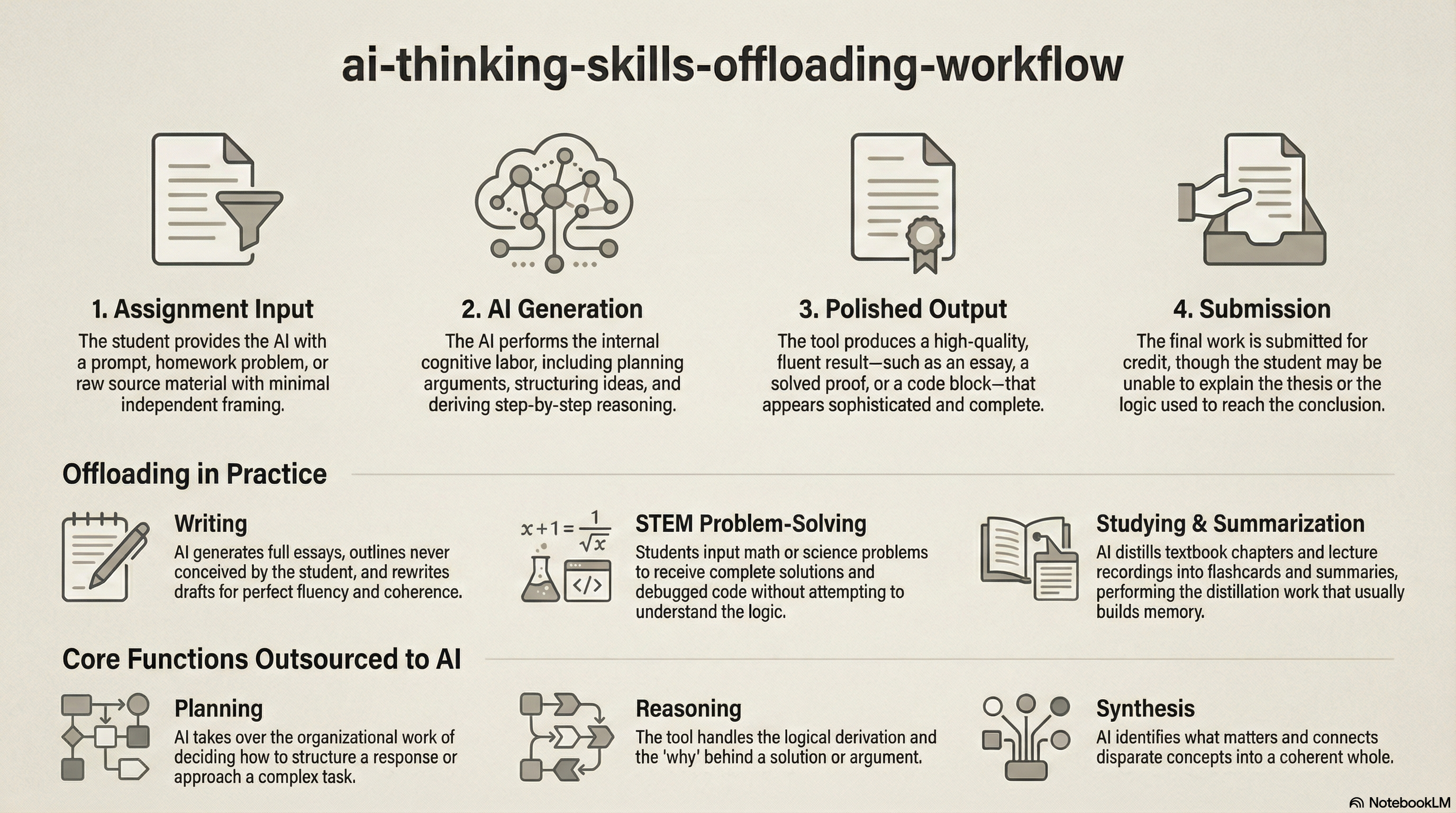
In writing assignments, students use AI to generate full essays from minimal prompts, rewrite drafts for fluency and coherence, and produce outlines they never conceived themselves. The tool doesn’t just help them write—it does the writing, including the invisible work of planning arguments, selecting evidence, and structuring ideas.
In STEM courses, students input homework problems directly into AI systems and receive complete solutions with step-by-step explanations. They aren’t using the tool to check their work or clarify a concept they’ve struggled with. They’re bypassing the work entirely, copying the reasoning pattern without ever deriving it themselves. Computer science students use AI to debug code they haven’t attempted to understand, or to generate functions they haven’t tried to write.
For studying, the offloading is more subtle, and potentially more consequential. Students feed lecture recordings and textbook chapters into AI and ask for summaries, flashcards, or practice questions. The tool identifies what matters, distills concepts, and makes connections—precisely the cognitive labor that transforms exposure into learning.
The crucial distinction is this: these aren’t students using AI to clarify a concept after wrestling with it. They’re using it as a replacement for the thinking itself.
When Tools Become Substitutes
There is a meaningful difference between tool-assisted learning and skill replacement.
Tool-assisted learning happens when a student remains cognitively engaged—using AI to test understanding, identify weak points, or explore alternatives after attempting a problem independently. The student retains ownership of the intellectual work.
Skill replacement occurs when the tool performs the core component of the task. When a student asks AI to write the essay, solve the proof, or explain why a historical event matters, the cognitive steps that build competence never occur. The assignment is completed. The skill is not developed.
Educators are increasingly observing something beyond skill replacement: over-reliance.
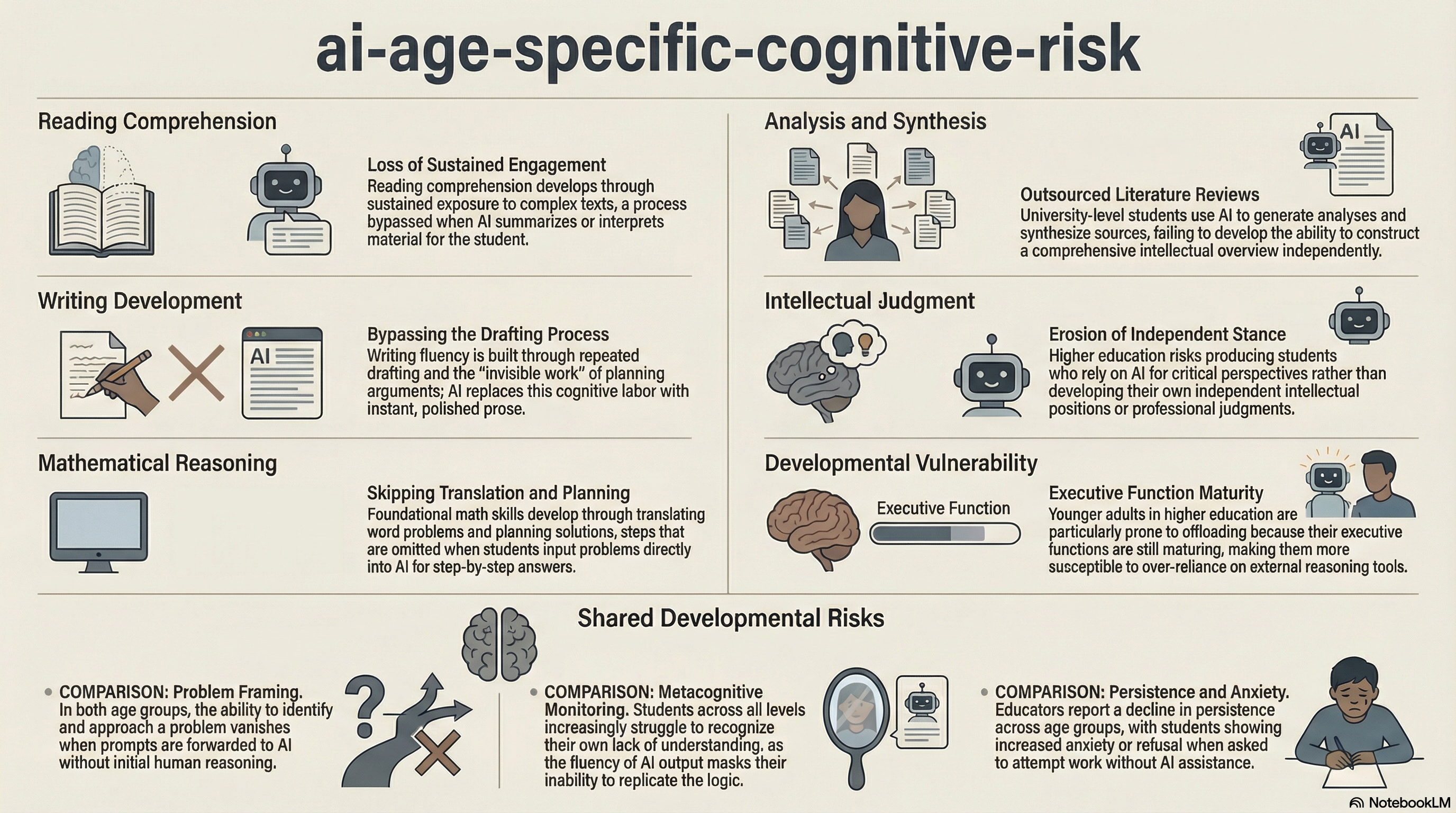
Students exhibit anxiety or refusal when asked to attempt work without AI. They default to offloading before making any independent attempt at reasoning. Some appear to have internalized the idea that thinking without external assistance is unnecessary—or even pointless.
Why This Is Different From Calculators
The comparison to calculators is tempting. It’s also misleading.
A calculator processes symbolic input and returns a numerical output. It doesn’t interpret the question, explain its reasoning, or handle the conceptual work of setting up the problem. Students must still translate word problems, choose operations, and judge whether answers make sense.
Spellcheck compares text against fixed rules. Search engines provide fragments that users must still evaluate and synthesize.
Generative AI collapses that distinction. It interprets open-ended prompts and performs the entire sequence from question to polished answer. A student can request an essay on the causes of the Civil War and receive a coherent, persuasive document without engaging in the cognitive processes that make writing educationally valuable.
This isn’t assistance. It’s substitution.
The Thinking Steps That Disappear
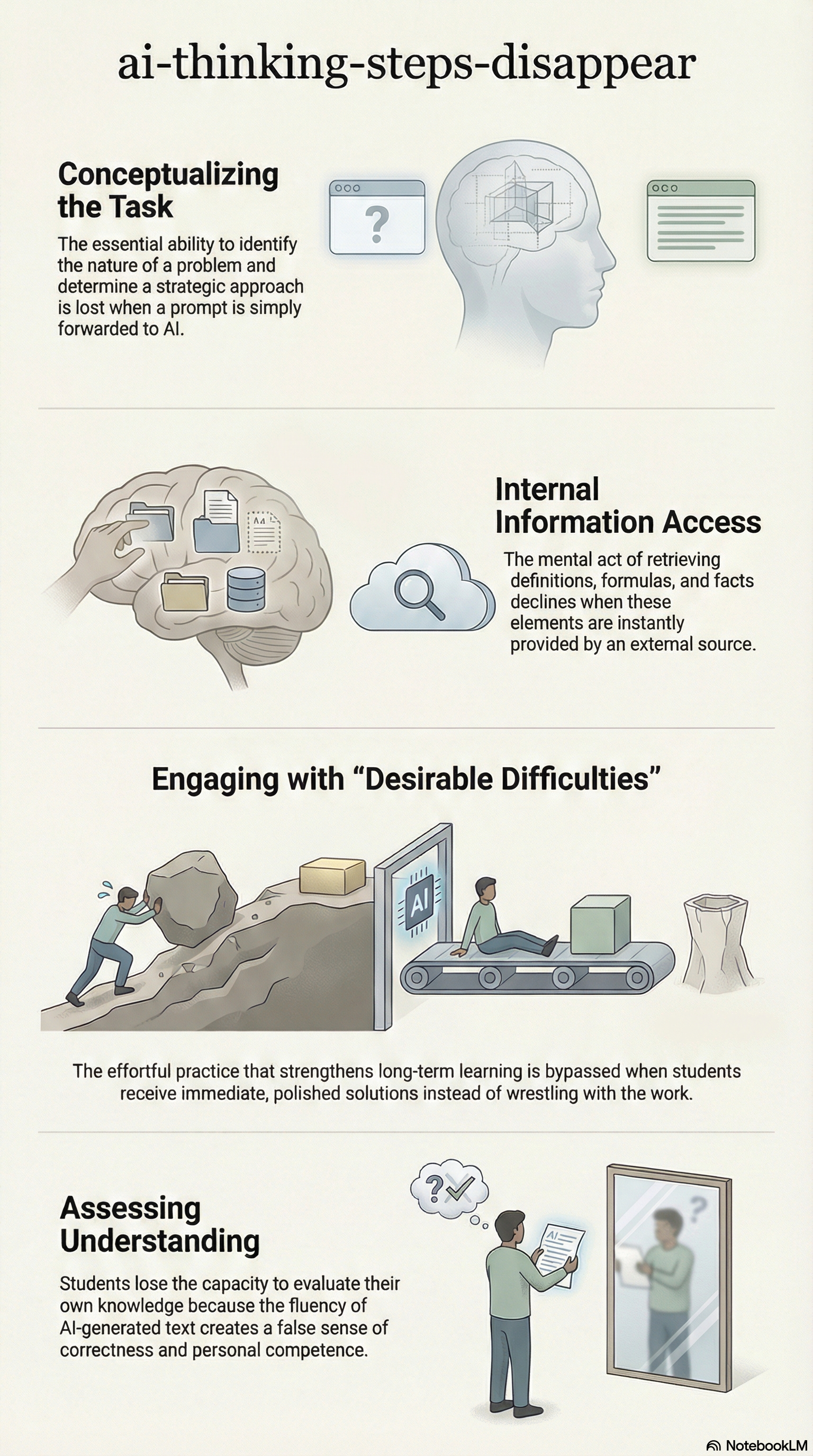
When students offload these tasks to AI, specific stages of cognition are reduced or skipped entirely.
Problem framing—the ability to identify what a problem actually is and how to approach it—vanishes when prompts are simply forwarded to AI. Retrieval and recall decline when definitions and formulas are instantly available. “Desirable difficulties,†the effortful practice that strengthens long-term learning, disappear when polished solutions arrive immediately.
Perhaps most concerning is the loss of metacognitive monitoring. Students submit work they haven’t thought through because fluent AI output masks their own lack of understanding. They assume coherence equals correctness.
What the Research Is Beginning to Show
The evidence is still developing, but the pattern is consistent.
Studies show a negative correlation between heavy AI reliance and critical-thinking performance, with measurable drops in reasoning and retention among frequent users. Importantly, these findings are correlational, not causal. They show association, not proof.
But they align with decades of cognitive science. When tools remove the effort required to build mental structures, learning suffers.
Different Ages, Different Risks
In K–12 education, the concern centers on foundational skills. Reading comprehension develops through sustained exposure to complex texts. Writing fluency develops through repeated drafting. Mathematical reasoning develops through translation and planning. AI allows students to bypass all three.
At the university level, the risk shifts to synthesis and judgment. Students use AI to generate analyses and literature reviews without developing an independent intellectual stance. Younger adults, whose executive functions are still maturing, appear particularly prone to offloading.
What Educators Are Seeing
Teachers report a growing gap between the quality of submitted work and students’ ability to explain it. Polished essays collapse under basic questioning. Persistence declines. Students give up faster when AI is unavailable.
Some instructors now rely on oral exams and in-class assessments to verify understanding. The discrepancy has become too large to ignore.
What We Know and What We Don’t
We know that AI-driven cognitive offloading now extends to analysis and composition. We know it differs fundamentally from previous tools. We know heavy reliance is associated with weaker independent thinking.
What we don’t know is how permanent these effects will be, where safe boundaries lie, or whether education systems can adapt fast enough to preserve deep learning.
Where This Leaves Us
A student who uses AI to complete assignments learns to complete assignments. They may not learn to think.
The grade looks the same. The transcript looks the same. But the cognitive development school is meant to produce may not be happening at all.
The costs are delayed and invisible. The honest students—those who struggle, who think, who produce rougher work—are at a short-term disadvantage.
They may also be the only ones actually learning.