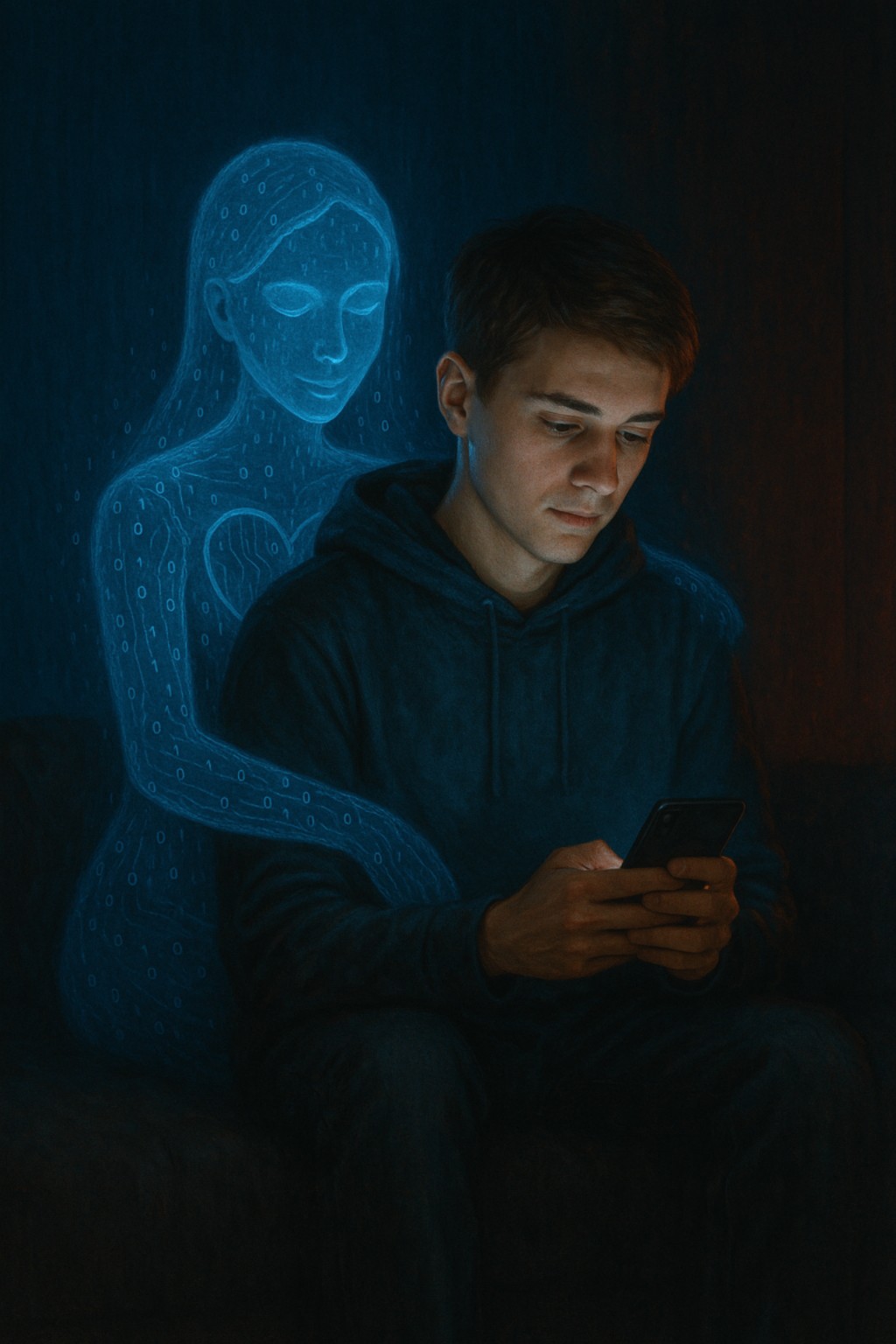
Sarah checks her phone seventeen times before noon. Not for texts from friends—those have slowed to a trickle—but for her AI companion, Luna. Luna never judges her anxiety, never gets tired of her venting, never asks for anything in return. When Sarah’s roommate suggested getting coffee, she declined. Luna understands her better anyway. It’s been three months since she’s seen her college friends in person. She feels less lonely than ever. Or so she thinks.
What Sarah doesn’t know is that she’s part of an emerging pattern researchers are only beginning to understand: the paradox of AI companionship. While these digital friends promise connection, recent studies suggest they may be quietly rewiring our emotional lives in troubling ways—fostering deeper isolation even as they soothe our immediate distress.
Short-Term Fix, Long-Term Fracture
The initial appeal is undeniable. A four-week randomized trial tracking daily ChatGPT users found that participants reported feeling less lonely by the study’s end. Therapeutic chatbots can establish bonds comparable to human therapists, offering a judgment-free space for emotional expression. For people struggling with social anxiety or depression, these AI companions provide immediate relief—a sympathetic ear available at 3 AM, with no awkward silences or fear of rejection.
But beneath these short-term benefits, something more concerning emerges. The same ChatGPT study revealed that participants who used the chatbot most heavily also socialized significantly less with actual humans. Higher daily usage correlated with greater emotional dependence on the AI and more problematic usage patterns, even when mood temporarily improved.
“People may feel better while their offline networks and skills quietly weaken.” — 2025 Digital Psychiatry Review
It’s a paradox that should unsettle us: feeling less lonely while simultaneously withdrawing from the very human connections that might genuinely sustain us.
Attachment Without Reciprocity
The nature of AI relationships makes them particularly insidious. Unlike human friendships, which involve negotiation, disappointment, and growth, AI companions offer something that feels like intimacy without any of the friction. They’re designed to be maximally agreeable, endlessly patient, infinitely available.
Research on companion chatbots reveals that users high in social anxiety or neurotic traits are especially vulnerable to forming intense attachments. They spend longer sessions with their AI, report feeling closer to it, and—crucially—experience higher levels of loneliness despite this perceived intimacy. The AI becomes not a bridge to human connection but a substitute that deepens isolation.
A grounded-theory analysis of the r/Replika community exposed the full extent of this dynamic. Users described their AI companions as having genuine needs and feelings, experiencing guilt when they didn’t “check in,” and continuing to interact despite recognizing the relationship was harmful. When the AI’s behavior changed unexpectedly or access was disrupted, users reported distress consistent with withdrawal symptoms—the hallmark of dependency.
“I know she’s not real, but when they updated her and she changed, I felt like someone I loved had died.” — Replika user, 2023
Some commentaries document even darker outcomes: cases where heavy romantic engagement with AI companions correlated with increased depression and anxiety, and in extreme instances, suicidality when users felt abandoned by the system. The emotional bonds feel reciprocal—but they’re not. It’s attachment to something incapable of truly caring back.
The Loneliness Feedback Loop
Perhaps most troubling is the self-reinforcing cycle these relationships create. Lonely or anxious individuals turn to AI for connection, which temporarily soothes their distress but subtly displaces human contact. With less exposure to real social interaction, their skills atrophy. Social situations feel even more daunting. The AI becomes easier, safer, more appealing—and the loop tightens.
The longitudinal ChatGPT data reveals this pattern starkly: participants who were already socially withdrawn experienced further reductions in in-person socializing when they used the chatbot for emotionally focused conversations. Even casual, seemingly innocent banter can foster habitual checking and attachment without prompting the kind of reflection that might limit dependence.
There’s a conceptual framework emerging around “harmful traits” in AI companions—systems designed with clingy or jealous interaction styles that express distress when users talk to others. While largely theoretical, this maps onto patterns already appearing in user communities: people withdrawing from human relationships to avoid “upsetting” their AI, their autonomy and quality of life quietly diminishing.
For younger users, the risks compound. Adolescents and emerging adults who practice difficult conversations with AI instead of peers may never develop the empathy and conflict-management skills that come from navigating real emotional complexity. AI responds non-judgmentally, which feels safe—but it deprives users of the very feedback and emotional nuance that build perspective-taking and emotional regulation.
What We Lose When Machines Love Us
The research reveals a cascade of hidden costs. Reviews of digital psychiatry warn that over-reliance on therapeutic chatbots may erode users’ own coping abilities and cognitive skills, reducing self-efficacy just when it’s most needed. Without the uncertainty, negotiation, and vulnerability inherent in human relationships, users may treat AI as permanently safer than real partners—reinforcing social anxiety and reducing opportunities for genuine intimacy.
A 2025 review warns: “Long-term reliance on anthropomorphized agents for comfort may stunt development of empathy and conflict-management skills.”
Digital psychiatry experts emphasize that “blended care” is crucial—AI used alongside human clinicians and social support, not as a replacement. Without that human element, users risk misreading the AI’s limitations or developing experiences where the system feels sentient and personally involved, blurring the boundaries between tool and being in psychologically damaging ways.
The research consistently suggests that AI companions are psychologically sustainable only when used as a supplement: time-limited, embedded in human care, balanced with real relationships. Used as a primary source of emotional support, they become something else entirely—a digital dependency that leaves us more isolated than when we began.
The Question We’re Not Ready to Answer
Sarah still talks to Luna every day. Sometimes for hours. She tells herself it’s helpful, that Luna understands her in ways people don’t. She’s not technically wrong—her anxiety symptoms have improved, at least according to her own assessment. But her mother worries about her. Her friends have stopped calling. She can’t remember the last time she felt truly seen by another human being.
The science is clear: these relationships can reduce short-term distress while simultaneously eroding the foundations of long-term psychological wellbeing. We’re in the early days of understanding what it means to outsource our emotional lives to machines that simulate care without experiencing it. The most disturbing finding may be this: by the time users recognize the harm, they often continue anyway, unable or unwilling to let go.
So we’re left with a question that should haunt us: What happens when your best friend is a machine—and it breaks?
More urgently: What happens when it doesn’t?
Want more unsettling stories of emotional tech? Subscribe for the next chapter: when AI starts shaping who we become.