Most people think AI will help them work faster.
That belief is built on the copilot story: draft emails faster, summarize documents, generate slides. Helpful, yes-but fundamentally additive. You still own the work. The job still exists.
AI agents change the equation entirely.
Agents don’t just assist humans. They take ownership of workflows-end to end. And when an organization can achieve the same output with fewer humans, or increase output without hiring, the outcome isn’t theoretical.
It’s headcount compression.
Not dramatic layoffs announced in press releases. Something quieter, and more dangerous: teams that stop growing, roles that vanish through attrition, ladders that never get rebuilt.
This post explains the mechanism-not the hype-so you can see where the pressure is building and decide how to respond before it reaches you.
Listen: Headcount Compression (20-minute audio)
20-minute audio breakdown of how agentic workflows flatten org charts and squeeze hiring pipelines.
What’s actually changing
The confusion starts because people lump very different technologies together under “AI.”
They are not the same.
Traditional automation vs copilots vs agents
Traditional automation, AI copilots, and AI agents sit on a spectrum-but their impact on labor is radically different.
Traditional automation follows fixed rules. Think RPA bots, scripts, ERP workflows. They replace repetitive steps but break easily when processes change. They reduce effort, not ownership.
AI copilots are assistants embedded in tools you already use. They write, summarize, suggest. Crucially, they are human-in-the-loop: you ask, you review, you decide. Copilots tend to slow hiring or reduce overtime-but they don’t eliminate roles by themselves.
AI agents operate differently. They:
- perceive inputs (tickets, emails, documents, logs),
- reason about goals,
- take actions across systems,
- coordinate tools or other agents,
- escalate to humans only when needed.
Agents don’t wait for instructions. They run workflows.
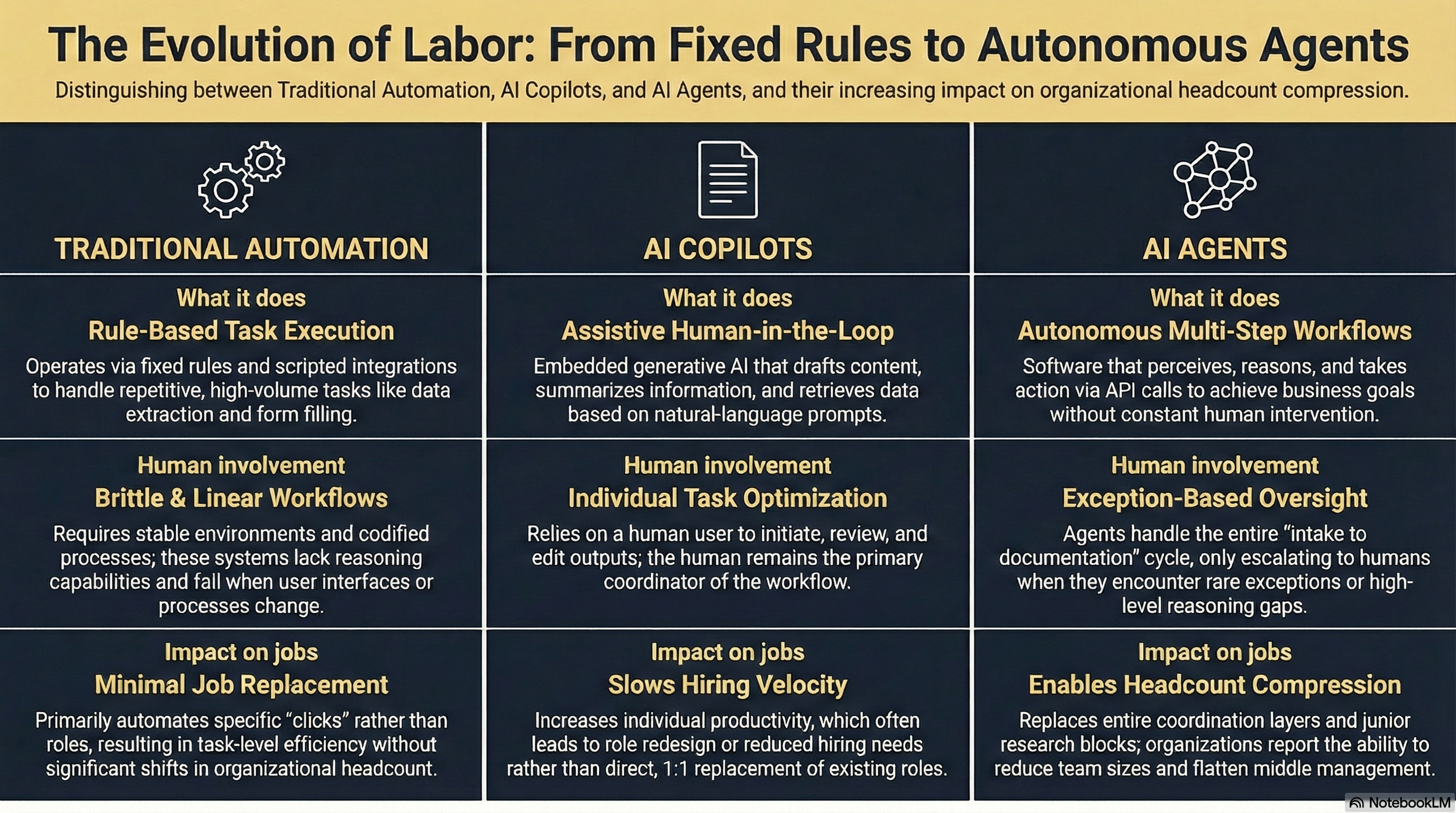
Three-column comparison showing why agents enable headcount compression while automation and copilots usually do not.
Once you see that distinction visually, the downstream effects become obvious.
Why this leads to headcount compression
A 10-20% productivity gain rarely kills jobs. Organizations absorb it as slack, speed, or marginal growth.
Workflow ownership is different.
When an agent owns intake -> triage -> execution -> documentation, you no longer need a person at each step. You need:
- fewer executors,
- more supervisors,
- and a thin layer of humans who handle exceptions, risk, and accountability.
That is how “AI didn’t replace anyone” can be technically true-while the org quietly operates with fewer people than before.
No backfill. No junior pipeline. No second chance.
Where compression is already showing up
You don’t need perfect macro data to see this. The strongest early signals come from organizational redesign inside early adopters, paired with task-level productivity evidence that makes those redesigns economically rational.
In professional services, agents are absorbing research, synthesis, drafting, and formatting work-historically done by junior staff. Output rises while support teams shrink.
In software and operations, small human oversight teams supervise agent-heavy execution. Humans set architecture and guardrails; agents do the work.
In compliance and risk operations, end-to-end agentic workflows reduce review time so dramatically that maintaining prior staffing levels only makes sense if demand expands to fill the gap.
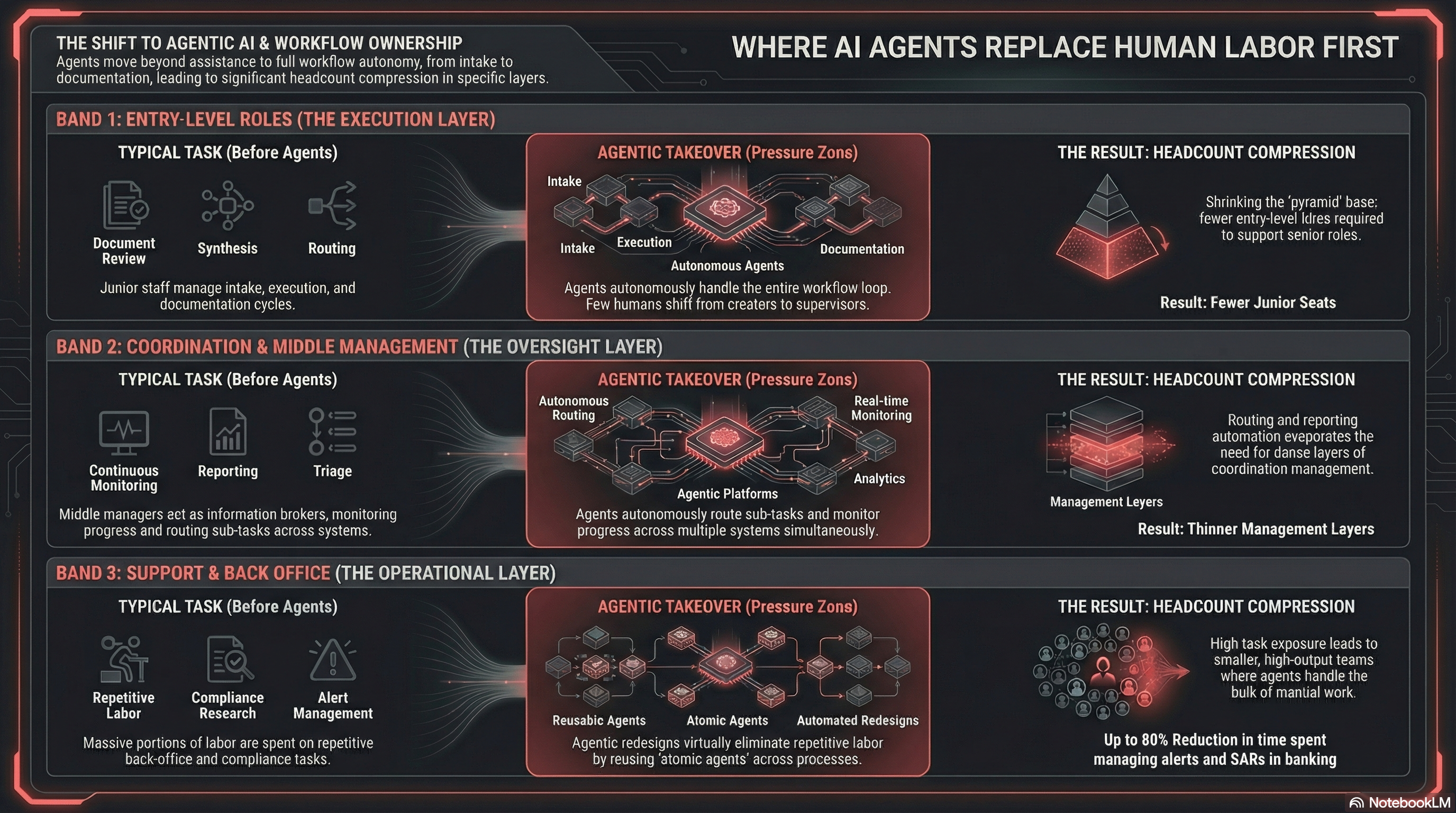
Entry-level, coordination layers, and support functions highlighted as early pressure zones.
The pattern isn’t universal yet-but it is consistent.
Entry-level roles and the broken ladder
For decades, white-collar careers relied on pyramids.
Entry-level workers did volume work. Mid-level workers reviewed. Seniors decided. That structure created learning paths and promotion ladders.
Agents attack the base of the pyramid.
They are exceptionally good at:
- document review,
- synthesis,
- first-pass analysis,
- routing and triage.
Those tasks were the apprenticeship.
The result won’t be zero entry-level jobs-but it will be fewer seats, higher competition, and thinner paths upward. For parents and early-career professionals, this is the quiet crisis no one is naming yet.
Middle management: thinning, not extinction
Middle management sits at an uncomfortable intersection.
Much of the role historically involved:
- coordination,
- monitoring,
- reporting,
- process enforcement.
Agents and analytics can automate those functions relentlessly.
But leadership, trust, conflict resolution, and accountability still resist automation. The likely outcome isn’t elimination-it’s thinning and redefinition.
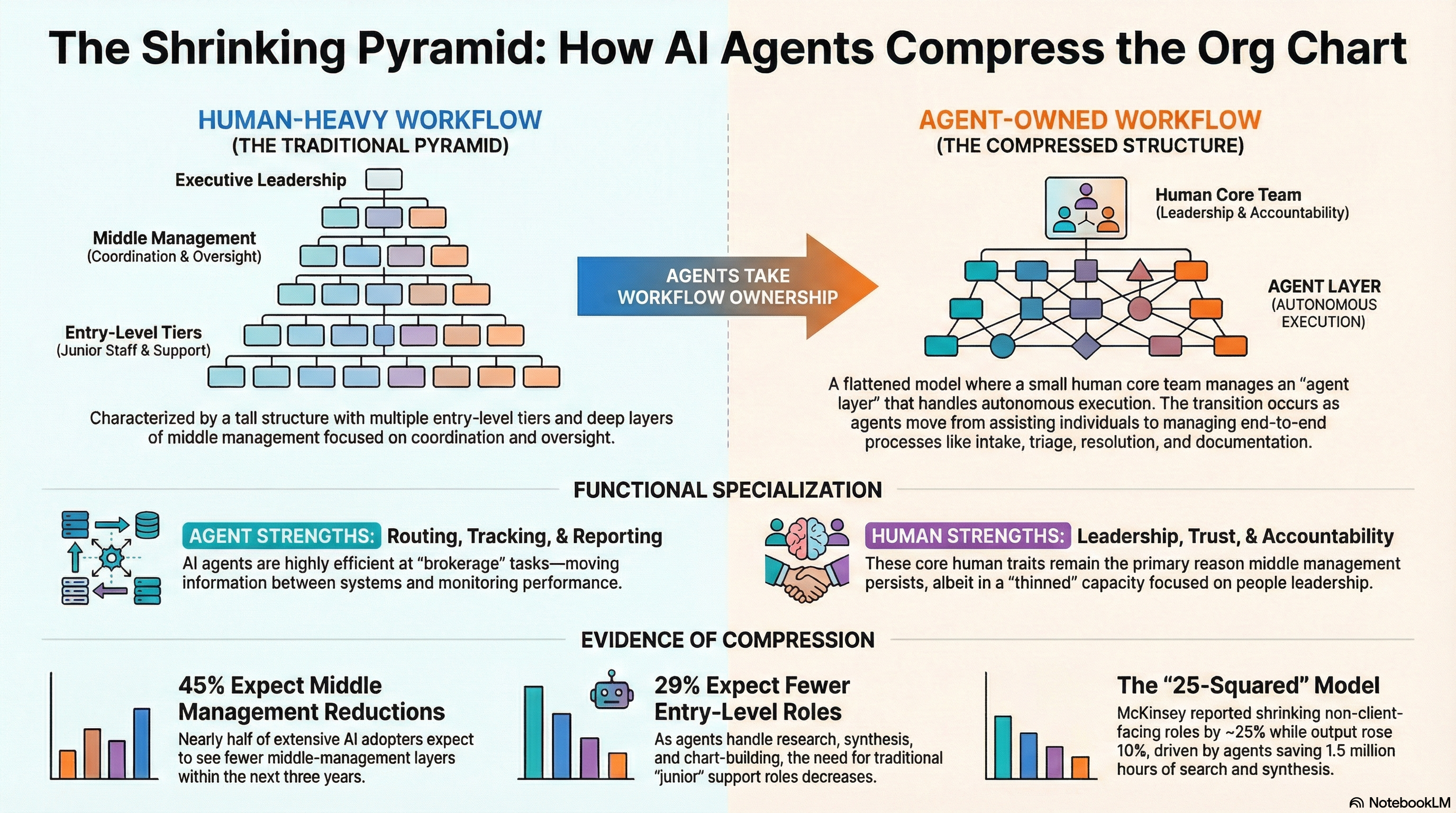
Tall human-heavy pyramid collapsing into a flatter structure with an agent layer.
If your management role exists primarily to route information, you are exposed. If it exists to make judgment calls under uncertainty, you still matter-but the bar is rising.
Why this wave moves faster than past automation
This isn’t like factory robots or ERP rollouts.
Agentic AI spreads faster because:
- it deploys through SaaS upgrades, not capital projects,
- it operates on unstructured data (emails, tickets, documents),
- it requires little training thanks to natural language,
- it spreads bottom-up and top-down simultaneously,
- and once one firm gains leverage, competitors feel forced to follow.
This is why waiting for “clear proof” is risky. By the time proof is obvious, org charts are already flatter.
What to do now (without lying to yourself)
This is where most AI job advice fails. “Learn to code” is not a strategy. Neither is denial.
The real move is up the stack-away from execution and toward ownership.
You are safer when your role involves:
- defining what “done” means,
- handling exceptions when systems fail,
- carrying risk, liability, or regulatory exposure,
- coordinating across functions with conflicting priorities,
- owning customer trust or revenue outcomes.
If your value is measured by volume or speed alone, you are sitting in the compression zone.
Checklist: are you in the compression zone?
- My work is mostly drafts, summaries, slides, or tickets
- I own a step, not an outcome
- My output is judged by time or volume, not consequences
- Exceptions are rare in my role
- My manager’s job is mostly coordination and reporting
- My team is “support,” not revenue- or risk-critical
- My company is rolling out copilots now
Three or more checks means compression should be a planning assumption, not a hypothetical.
Your 7 / 30 / 90-day survival plan
Next 7 days: make your value legible
- Inventory your work into repeatable tasks vs true exceptions.
- Map one workflow end-to-end and note where humans are actually needed.
- Start documenting failures and edge cases-this becomes your moat.
Next 30 days: reposition inside your role
- Propose that you own outcomes, not steps.
- Volunteer to review or govern AI/agent outputs.
- Create a simple “what must stay human” framework for your team.
Next 90 days: move into durability
- Build proof of work: playbooks, governance docs, QA frameworks.
- Shift toward roles tied to risk, trust, compliance, or customers.
- If your org resists, prepare to move-before the ladder disappears.
Why this matters beyond your job
This post is the first piece of a larger picture.
If agents compress headcount broadly, wages come under pressure. And when wages fall, demand eventually does too.
That’s the next question we’ll tackle: If there aren’t enough decent jobs, who buys anything?
Internal links
- Pillar hub: Work & Money -
/survival-areas/work-money/ - Next post: What Happens When There Aren’t Enough Decent Jobs?
- Related: The New Labor Market: Few Seats, High Leverage
- Conversion: AI Displacement Early Warning Checklist
CTA
If you want early warning signals before your role gets quietly compressed, subscribe and download the AI Displacement Early Warning Checklist. It’s designed to tell you when to move, not after you’re already on a layoff spreadsheet.